
Bay is one of the most versatile herbs used in cooking. Bay leaf plants are small trees, and the dried leaves are commonly used in the French ‘bouquet garni’ which can be added to flavour stews and soups.
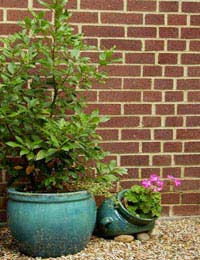
Bay is an evergreen tree with aromatic leaves and shiny grey bark. In spring it develops small, yellowish flowers and in autumn the tree bears dark, purple berries. It is a tall tree that is often kept small by growing it in a container. It is hardy to -7C but if temperatures fall below that the tree should be covered with horticultural fleece or taken indoors until the weather changes.
Jump To...
Varieties of Bay Leaf Plants
There are several varieties to choose from, including:-
- Aurea – young foliage is yellow.
- Angustifolia, or willow-leaf bay – leaves are narrower.
- Undulata – leaves have wavy edges.
Where to Grow Your Bay Leaf Plant
Your bay leaf plant should be sited in a sheltered area in full, or part sun. It can tolerate most soils, as long as it is well drained. Dig a deep hole 1m wide and deep and half-fill back with soil and organic matter such as well-rotted animal manure or compost. Place the tree in the soil so it stands straight. Check the original soil mark on the trunk and ensure the tree is sitting to the same depth. Fill the hole back with soil and firm the soil around the trunk with your feet. Water well.
Caring for Your Bay Tree
Bay trees can grow up to 12m (40ft) if left to grow unchecked, so you’ll need to prune your tree each year if you grow it outside. Pruning bay trees is easy – they can be kept to any height and width if pruned regularly. Use secateurs to simply snip the excess foliage away to form a circular shape. Bay trees have very shallow root systems. This means in very dry conditions you may need to water your tree but otherwise the bay requires little attention. Also be careful when weeding around the area as you could damage the root structure.
Growing Your Bay Tree in a Container
If you grow your bay tree in a container you will be able to move it inside during colder months. It will also require less pruning as the container will slow down the spread of roots and stunt the tree’s growth a little. Container-grown trees look fantastic on the patio and make good houseplants. Choose a pot roughly 30cm (12in) in diameter – this will allow the tree to reach a height of no more than 1.5m (5ft). Bay trees enjoy being pot-bound (where the roots appear to have out-grown the pot) so you will not need to re-pot the tree for about 5 years.
Make sure the pot has adequate drainage holes and place old crocks or stones at its base. Part fill it with a good quality soil-based compost and place the tree on top of the soil. Ensure the original soil line on the base of the trunk comes within the pot’s height, and fill with soil, firming gently. Water well and top up with compost if necessary.
You will still need to prune your container bay tree, trimming the leaves into the desired shape. Feed the tree fortnightly in summer months with an organic fertiliser such as seaweed, and replace the top 2cm of compost each spring. Move the tree indoors in cold weather; a cool area with plenty of light is ideal.
Tips for Successful Bay Leaf Growing
- If frost affects your tree, don’t panic. The leaves are likely to turn brown and wither. If only some of the leaves are affected, remove them in spring and give the tree a good feed. If all the leaves are affected, cut the tree down to about 15cm (6 inches) above soil level. New shoots will appear from the base in spring.
- If growing your tree in a container don’t water it too much in winter, let the compost dry out completely before adding more.
Bay leaf plants are easy to grow and maintain. Their leaves have many uses in the kitchen and are incredibly versatile. With a little pruning and care your tree will last for years, giving you an attractive feature that adds a little extra to stews and soups.
I have 2 standard bay tree 20 years old. the leaves have all turned brown and died. I live in West Yorkshire 2010/11 particularly bad winter and I failed to bring the plants indoors i am feeding the plants hoping to resusitate, should i cut off the leaves or leave and see what happens- and pray! Regards Christine Webb
I have a large bay tree, growing against a wood garage, and this year a lot of the leaves have gone brown and crispy. Even worse, there appears to be small spots of white fungus in clusters all over the trunk and branches. Does anyone else have these symptoms on their bays?!
I also live in West Yorkshire and have exactly the same problem as Christine – though mine also has little black spots on the leaves. Any advice would be most welcome! Gruber
I have the same problem as Sallyb-my bay tree has white {with brown spots within it} fungus spots on the trunk and i’m not at all sure what they are and what i can do about them.Can anyone help?
I also have the same problem( white spots on branches and yellowing leaves) on a very old bay tree ( at least 30 years old). Has anyone suggested a solution?
I have taken cuttings of a bay tree and have had them in a pot for 9 months but the leaves have gone brown and stiff although the cuttings seem to be firm in the soil should I leave them or do you think they are dead I dont know how to tell?
Have 2 bay trees in pots at the side of my front door,Does anyone know why they are both full of wasps,Had the plants 3yrs and never had this problem before,They must be at least 30 wasps on each plant,
My next door neighbour complaint about our growing bayleaf tree . He thinks that the root will cause a cracks on his wall . Is it true?
I have had a Bay tree in a pot for 20 years ,I was thinking of planting it outside ,it is about 8feet tall .can any one advise me on this .
i have grew a bay leaf tree in a pot for about 20 years ,it broke out of its pot and had to move and replant it ,to do this i had to cut the root as it had attached itself to a concrete slab.What is the best way to care for it now as the leaves are turning yellow and falling off.The leaves also look like they have been eaten and have lots of holes in and the trunk and branches have what looks like white fuzzy stuff on .
I have a Bay Leave tree in a pot. It is full of white spots on the leaves and trunk – I don’t really want o use it cooking as it is. It has been the same size for years and hardly any new leave. Just the old ones, dark green, full of spots. What can I do to fix this?
We have two healthy bay bushes in our garden, whats the best way to preserve leaves from this if we want to ?
@Davey111- you can simply hang the branches somewhere warm to dry then use the dry leaves in cooking. Alternatively you could preserve some in oil or vinegar. Take a look at our feature on preserving herbs for more information.
my bay tree has 2 shoots growing at the bottom of the trunk can I use these as cuttings? thank you
@snips. Give it a try! Here is some specific advice from the RHS that you may find useful.
I have been given a small bay tree in smallish pot for Mother’s Day. Over the last couple of weeks some of the leaves are starting to go brown. It is in the garden but in a sheltered position. I don’t think it has been cold enough here for it to be frost damage. Any ideas?
@Ed. Has it been over-watered (we’ve had a lot of rain)? Bay leaves turn brown in the cold and wind – while it’s not been especially cold, we have had a few frosty nights with strong winds, so this could also have been the cause. As in the article: If only some of the leaves are affected, remove them in a week or so when the weather improves and give the tree a good feed. If all the leaves are affected, cut the tree down to about 15cm (6 inches) above soil level. New shoots will appear from the base in spring.
My bay tree looks like it’s dying, it has white powdery spots on the trunk and the leaves are all going brown. Can I save it, I have cut it back. It’s also in a pot.
I have two beautiful standard bay trees planted in the ground in a sheltered garden which is situated in the sunny south of England. I have had one tree for about five years and the other for about ten. Could anyone provide me with an explanation as to why they have never flowered. Angela H
@Angie. Some bay trees never flower. Those that do are usually very mature ones. There is some excellent information here.
Hi, I was interested in herbs since my childhood, I seen my father doing this making herbs mixtures. I have a busy life but still take time out to do some experiments I have find a cure for hayfever, eye solution, anti biotic oil for any wounds still work on many things, looking to open a herbal company or partnership with, if someone read this give me a call
Hi, I’ve bought a dwarf bay tree about a couple months ago.It looks very healthy but lately I’ve noticed on the bottom leaves like they have been chewed on,is it possible that my cat is doing this? She loves chewing on my lemon grass. Thanks C.
@Chrissy. Usually one would assume this to be insect activity. It might be the result of bay suckers. These are sap-sucking insects that attack the foliage (usually during the summer). The RHS has more information here
Hi, I have a bay tree in my garden which is approximately 15 yrs old and currently about 14ft in height, it’s a very large shrub and I was wondering if I was to cut it down to half its height will it damage future growth?.
@N. We’ve found an answer for you from another website! The Garden Focused website tells us the following:
“Large bay trees withstand even very hard pruning very well including cutting back the main trunk, it’s difficult to permanently damage an established one. However they are well known for taking two or three years to get back into shape. Like many trees they are best pruned in late spring during a dry period. The plan of action, if you want to halve the size of a large bay tree without disfiguring it completely, would be to prune away about a quarter of the tree in year one then slightly less in year two and finally tidy it up to the required size in year three. Regular pruning after that annually in early spring will keep it to the size you want. It really is that simple!”
I have a bay laurel tree and it was in a pot and this year I put it in the ground anyway I noticed and the end of a couple of branches it fork out to about 6 little branches with new leaves and all the leaves died. up.What is wrong with it?
hw long does bay leaves tree take to begin harvesting.
MARTNAMM: assuming it’s a specimen in a pot, not one you grew from seed, you can start chopping leaves off right away, in fact if you want you can chop them off the day you buy it! Obviously, don’t cut them all off, but then why would you want to; you only ever use a couple at a time…
@Alcina. Thanks Alcina, exactly that.
Hi, I’m looking at buying some bay trees for our patio and keep them potted. How much will they grow each year if I bought smaller ones? Thanks, J
@Joeytam. A very small potted bay tree (of around 20 to 30 cm) should grow around 6 – 10 cm per year.
Hi, I’ve just purchased a large potted bay tree that’s about 6 foot tall, to sit to the side of our front door. Can I keep the tree in its pot and plant it in the ground? This would offer better security against thieves! Or do I need to take the tree out of the pot as then plant in the ground? We don’t want the tree to get any taller.
@Martin. You can keep the tree in its pot as long as water can still get to the roots.
Hi, we bought a couple of bays (approx 2ft tall) in large pots and told to water well once a week. We found that within a week many of the mature leaves developed a sort of slashed appearance like they’d been cut. There is new growth but it all looks a bit withered. Wondering if some kind of disease has set in? Or should we be watering far more often in this period of hot weather? We’ve positioned them in an area which gets good sun.
@Worldwiser. Without seeing them we can’t really say for sure but there are several problems that can be caused by pests such as vine weevils or fungal diseases such as shot hole – it’s worth doing more research on these to be sure it’s not the problem. Have you been feeding the bay trees? Make they’ve been fed according to advice given when you purchased them. Selectively remove just a few of the older leaves that look damaged and see how you get on.
We have a quite big bay tree (around 5 m tall) in our garden, to be precise is in our backyard deck. The previously owners built the deck around the tree. The tree is very close to the house and the fence. Our gardener suggested us to cut the tree as the roots will affect the foundations of the house and the fence. I don’t want to cut the tree but I don´t have any idea about the size of the roots and the way they grow. Can I have an advice? Is it true that the roots can affect the foundations? Is it possible to relocate a tree? Is there any service I could turn to? Many thanks. Simona
@SIMO. It doesn’t always follow that tree roots affect foundations of houses and walls. Here’s what Chris Overbeke – Senior Partner OMC Associates has to say on the matter- “Roots encountering a solid object will divert and follow the course of least resistance, thereby causing no damage. The continuous radial expansion of trunks and structural roots in contact with a structure and in a restricted space, however, can exert sufficient pressure to displace heavy structures.” He also says that indirect damage can be caused by the influence of a tree on soil moisture levels of a substrate prone to shrinkage and expansion. Here You will need to get a qualified surveyor to look at this for you. He/she will investigate the type of soil you have (substrate shrinkability makes a difference), the amount of water uptake the tree roots of that type of bay tree will need, the type/age of your foundations etc etc.
My young bay leaf plant in a pot all leaves became pale gree and brittle. What do I do
How tall (approximately) could a 2m potted tree grow if moved to a well drained planter 3m wide (L) , 90cm high (H) and 50cm deep (B) thats got connection to an irrigation system. In Southern Mediterranean conditions. Planter is built over deck tiles close to a pool done with anti root membrane. Chances of roots getting into the ground and damaging deck? Many many thanks
I have an 8ft / 2.5m high established bay tree in the garden. When I prune it should I keep some of the new leaf growth or older darker leaf for cooking with?
We have a large bay in our garden which has been there over 20 years. From the ground alongside the main trunk we have 2 side trunks about 8 inches diameter and about 6 ft tall. We wondered if bay is like willow and will self root of we cut off one of the side trunks and plant it elsewhere?
Hi I have a large bay tree in my garden and it has 3 significant side trunks about 10 inches in diameter. We were thinking of removing one and planting it somewhere else. Does anyone know if bay is like willow and will self root?
Hi, my bayleaf has shiny sloghtly sticky cover on the leaves which also drops on the floor. I have realised that it may have some desease as the branches are also covered by small kind of insects. What do i do to get rid of them? Thank you.
Hi my bay tree leaves are getting very dry I water it is there anything I can give extra to help this problem
Hi I have a bay tree thats 10ft away from my house the tree is approximately 20ft high will this cause a problem to the foundations Regards Barry
I’m thinking of purchasing the Bay Laurel Tree – Laurus nobilis. Can this be grown in a pot?
Hello I have been growing a bay tree in a pot (a succession of pots) for about 35 years, from about a foot high. Its been moved from shade to part sun at different times and does fine. Clipped to a ball shape so its kept in check. Also bought 2 more bays in pots about 10 years ago and they are also ok.
Hi. I have just taken delivery of two 70cm high standard bays. It is possible to use the self watering wicking method on these trees? The method would be to place wicking material from the bottom three inches into the pot through the drain holes which then dangles down into a water reservoir the tree sits on. The reservoir and tree would sit inside a pot which has drainage hole at the bottom. Or would it be better to sit it on capillary matting that receives water from a reservoir?